· VedicQ · Vedic Astrology · 5 min read
The Computational Dharma of Jyotish - How AI is Transforming Vedic Astrology Predictions
Discover how modern computational systems and AI are restoring the original precision of Vedic Astrology through deterministic calculations, Shadbala analysis, Dasha systems, divisional charts, and authentic Jyotish principles.

🚀 Meet VedicQ: Your Authentic AstroChart AI Advisor
Instantly generate your precise Kundli and divisional charts (D1, D2, D4, D7, D9, D10, and more) with no waiting and no pandit needed, and chat or talk to our 24/7 Live AI Astrologer with real-time voice call in 100+ languages.
Get detailed predictions, Yogas, Doshas, Vimshottari Dasha, and Shadbala calculations based purely on Vedic principles, not random AI.
🎁 Experience pure astrology with zero guesswork. Try both AI Chat and Live Voice Talk free today using the promo code: WELCOME25.


The Computational Dharma of Jyotish: How AI is Transforming Vedic Astrology Predictions
For thousands of years, Vedic Astrology — known traditionally as Jyotish Shastra — has been regarded as the sacred science of karmic illumination. The ancient Rishis did not describe Jyotish as superstition, intuition, or symbolic psychology. They described it as a precise cosmic framework capable of decoding the unfoldment of karma through astronomical mathematics and divine timing.
Today, however, much of modern astrology has drifted away from its original foundations. Generic horoscopes, simplified interpretations of the twelve vedic astrology signs, and superficial personality readings have replaced the rigorous analytical discipline preserved within the classical scriptures.
Yet anyone who has seriously studied authentic vedic astrology books such as the Brihat Parashara Hora Shastra, Sarvartha Chintamani, or Phaladeepika understands one undeniable truth:
Jyotish was built as a computational science.
The sages engineered an extraordinarily advanced predictive system based on:
- Planetary dignity
- Nakshatra architecture
- Dasha activation
- Divisional charts
- Ashtakavarga scoring
- Shadbala calculations
- Yogas
- Dispositor chains
- Graha avasthas
The challenge in vedic astrology today is not whether these principles work.
The real challenge is whether a human practitioner can consistently process thousands of interconnected variables without interpretative error.
This is where advanced computational systems and AI-assisted Jyotish are beginning to revolutionize the future of predictive astrology.
Why Most Vedic Astrology Predictions Fail
Many modern systems generate vedic astrology predictions by analyzing planets in isolation.
This approach directly contradicts classical Jyotish principles.
In authentic Vedic Astrology, no Graha acts independently. Every planet functions through layers of karmic delegation and planetary governance.
Consider Rahu placed in Mesha (Aries).
A superficial reading may immediately associate Rahu with obsession, ambition, foreign influence, or material hunger. But classical Jyotish demands a far deeper analysis.
Rahu in Aries cannot be judged independently because Rahu operates through the agency of Mars — the dispositor and ruler of Mesha.
This single principle changes the entire interpretation.
If Mars is:
- debilitated,
- combust,
- defeated in Graha Yuddha,
- weak in Shadbala,
- afflicted in Navamsa,
- or constrained by malefic drishti,
then Rahu’s Mahadasha may produce instability, conflict, and karmic turbulence regardless of Rahu’s apparent strength.
Conversely, if Mars is exalted and fortified across divisional charts, the same Rahu placement may produce:
- political influence,
- technological success,
- entrepreneurial rise,
- military leadership,
- or fearless ambition.
This is not mystical guesswork.
This is deterministic karmic architecture.
The Rise of the Vedic Astrology Calculator
Traditional astrologers once spent hours manually computing planetary strengths, divisional placements, and Dasha sequences.
Today, a modern vedic astrology calculator can process these astronomical computations within seconds — with far greater mathematical consistency than manual methods.
However, not every system deserves to be called authentic Jyotish software.
Most online tools merely generate generalized text descriptions based on Sun signs or simplified planetary placements. Authentic computation requires far more depth.
A serious vedic astrology birth chart calculator must evaluate:
- Exact planetary longitude
- Nakshatra and Pada placement
- Divisional charts (Vargas)
- Shadbala strength
- Ashtakavarga bindus
- Planetary avasthas
- Yogakaraka status
- Functional benefic and malefic roles
- Dasha activation timing
- Planetary dispositorship chains
Without these layers, even a visually accurate vedic astrology birth chart remains incomplete.
The future of Jyotish belongs to systems capable of executing these calculations with scriptural precision.
Beyond Generic Horoscopes: The Science of the Birth Chart
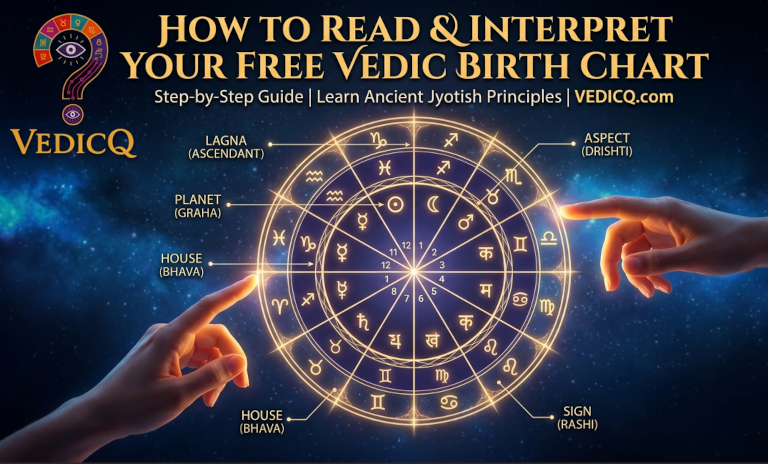
An authentic free vedic astrology chart is not merely a symbolic diagram of planets.
It is a karmic blueprint.
Every Graha placement represents:
- unresolved samskaras,
- inherited karmic patterns,
- psychological conditioning,
- spiritual tendencies,
- and temporal cycles of manifestation.
This is why the Lagna, Moon Nakshatra, divisional charts, and Dasha systems must all be analyzed simultaneously.
The birth chart is not static.
It unfolds dynamically through time.
The Vimshottari Dasha system acts as the master karmic clock governing when latent karmas become materially active. A planet may appear powerful in the natal chart yet remain dormant until its Dasha period activates its karmic agenda.
This is where advanced AI-assisted computation becomes invaluable.
AI and the Restoration of Classical Jyotish
There is widespread misunderstanding about artificial intelligence in astrology.
True AI-assisted Jyotish is not about replacing the astrologer with a chatbot generating mystical affirmations.
Authentic integration means building deterministic systems rooted entirely in classical rules.
The computational engine performs:
- astronomical calculations,
- Shadbala measurements,
- Dasha sequencing,
- divisional chart analysis,
- Ashtakavarga scoring,
- and dispositor tracing.
The interpretative layer then translates these verified calculations into coherent language while remaining constrained by scriptural logic.
In this structure:
- the AI does not invent,
- speculate,
- or hallucinate predictions.
It executes Jyotish Siddhanta exactly as prescribed in the classical tradition.
This restores consistency to vedic astrology predictions while preserving the integrity of the ancient science.
The Importance of Saturn and the Shani Sade Sati Calculator
Among all planetary cycles, few are feared more than Shani’s transit over the natal Moon — commonly known as Sade Sati.
Yet classical Jyotish never described Sade Sati as universally destructive.
Its effects depend entirely upon:
- Saturn’s dignity,
- house rulership,
- Nakshatra placement,
- Ashtakavarga strength,
- and Dasha interaction.
A properly designed Shani Sade Sati calculator must therefore go far beyond merely identifying Saturn’s transit through three zodiac signs.
It must evaluate:
- whether Saturn is a Yogakaraka,
- whether it gains directional strength,
- whether it is supported by benefics,
- and whether the Moon itself is fortified.
Without this deeper computational framework, predictions become unnecessarily fear-driven and inaccurate.
The Future of Vedic Astrology Today
The future of vedic astrology today will not belong to vague spiritual content or generalized horoscope systems.
It will belong to platforms capable of preserving the original computational sophistication of Jyotish.
The ancient sages never feared mathematics.
In fact, Jyotish itself was built upon astronomical precision and cosmic timing.
Modern computational systems simply allow us to execute those same principles with:
- greater consistency,
- deeper analytical depth,
- reduced human error,
- and unprecedented predictive accuracy.
When authentic scriptural logic is combined with advanced computational architecture, Jyotish returns to what it was always meant to be:
A precise science of karmic illumination.
Not guesswork.
Not entertainment.
But the mathematics of destiny itself.