· VedicQ · Tutorials · 5 min read
How to Read & Interpret Your Free Vedic Birth Chart | Step-by-Step Guide
Learn how to read and interpret your free Vedic birth chart with this comprehensive beginner's guide. Understand planetary positions, houses, signs, and how they shape your destiny according to ancient Jyotish principles.
🚀 Meet VedicQ: Your Authentic AstroChart AI Advisor
Instantly generate your precise Kundli and divisional charts (D1, D2, D4, D7, D9, D10, and more) with no waiting and no pandit needed, and chat or talk to our 24/7 Live AI Astrologer with real-time voice call in 100+ languages.
Get detailed predictions, Yogas, Doshas, Vimshottari Dasha, and Shadbala calculations based purely on Vedic principles, not random AI.
🎁 Experience pure astrology with zero guesswork. Try both AI Chat and Live Voice Talk free today using the promo code: WELCOME25.


How to Read & Interpret Your Free Vedic Birth Chart: A Step-by-Step Guide
You’ve generated your free Vedic birth chart - now what? Understanding your Kundli can feel overwhelming with its complex symbols and interconnected meanings. This guide will walk you through every element of your chart so you can begin to decode your cosmic blueprint.
Table of Contents
- Getting Started with Your Vedic Birth Chart
- Understanding the Signs (Rashis)
- Decoding the Houses (Bhavas)
- Interpreting Planetary Positions
- Reading Aspects and Conjunctions
- Understanding Your Ascendant (Lagna)
- The Moon Sign - Your Inner Self
- Common Patterns to Look For
- Putting It All Together
1. Getting Started with Your Vedic Birth Chart
What You’ll See in Your Chart
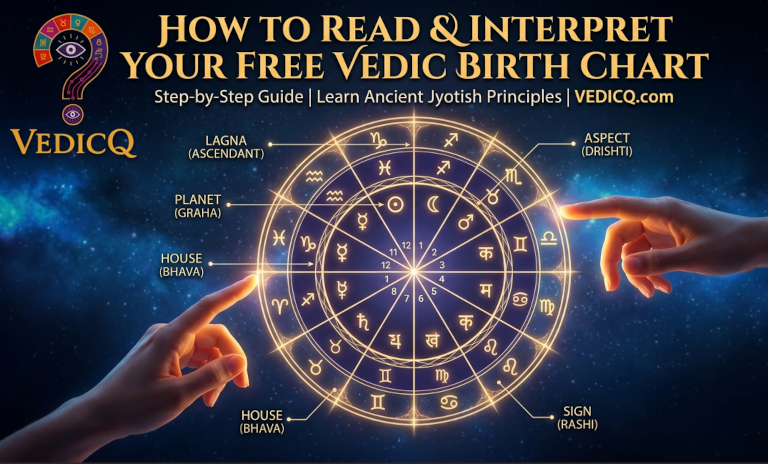
When you generate a free Vedic birth chart, you’ll typically see a circular diagram divided into 12 sections. Here’s what each element represents:
| Element | What It Shows | Why It Matters |
|---|---|---|
| Rashis (Signs) | The 12 zodiac signs around the outer ring | Determines how planetary energies express themselves |
| Bhavas (Houses) | The 12 inner divisions | Represents different life areas |
| Grahas (Planets) | Planetary symbols in each section | Active energies influencing your chart |
| Aspects (Drishti) | Lines connecting planets | How planets influence each other |
| Lagna | The rising sign | Your outer personality and how others perceive you |
Key Terminology
Before diving deeper, familiarize yourself with these essential terms:
- Kundli/Horoscope: Your birth chart
- Lagna: Ascendant or rising sign
- Chandra Lagna: Moon sign
- Surya Lagna: Sun sign
- Hora: Divisional chart for wealth
- Navamsa: Divisional chart for marriage and soul
- Dasha: Planetary period system
- Gochar: Current transits
2. Understanding the Signs (Rashis)
The 12 Zodiac Signs in Vedic Astrology
Each sign has three key qualities:
- Element: Fire, Earth, Air, or Water
- Quality: Cardinal (initiating), Fixed (stable), or Mutable (adjusting)
- Gender: Masculine or Feminine
Quick Reference: All 12 Rashis
| Sign | Sanskrit | Element | Quality | Ruled By |
|---|---|---|---|---|
| ♈ Aries | Mesha | Fire | Cardinal | Mars |
| ♉ Taurus | Vrishabha | Earth | Fixed | Venus |
| ♊ Gemini | Mithuna | Air | Mutable | Mercury |
| ♋ Cancer | Karka | Water | Cardinal | Moon |
| ♌ Leo | Simha | Fire | Fixed | Sun |
| ♍ Virgo | Kanya | Earth | Mutable | Mercury |
| ♎ Libra | Tula | Air | Cardinal | Venus |
| ♏ Scorpio | Vrishchika | Water | Fixed | Mars/Ketu |
| ♐ Sagittarius | Dhanu | Fire | Mutable | Jupiter |
| ♑ Capricorn | Makara | Earth | Cardinal | Saturn |
| ♒ Aquarius | Kumbha | Air | Fixed | Saturn/Rahu |
| ♓ Pisces | Meena | Water | Mutable | Jupiter/Ketu |
What Sign Placement Means
When a planet is in a sign, it expresses that sign’s qualities:
- Sun in Aries: Bold, pioneering leadership style
- Moon in Cancer: Deep emotional sensitivity and nurturing nature
- Venus in Scorpio: Intense passion in relationships, transformative love
3. Decoding the Houses (Bhavas)
The 12 Houses and Their Meanings
Each house governs specific life areas. Understanding house placement helps you know WHERE planetary energies manifest.
| House | Sanskrit | Key Life Areas | House | Sanskrit | Key Life Areas |
|---|---|---|---|---|---|
| 1st | Lagna | Self, personality, health | 7th | Kama | Marriage, partnerships |
| 2nd | Dhana | Wealth, family, speech | 8th | Mrityu | Longevity, transformation |
| 3rd | Sahaja | Siblings, courage, communication | 9th | Bhagya | Fortune, spirituality |
| 4th | Sukha | Home, mother, happiness | 10th | Karma | Career, reputation |
| 5th | Putra | Children, creativity, romance | 11th | Labha | Gains, friends |
| 6th | Roga | Health, enemies, service | 12th | Vyaya | Losses, foreign travel |
House Lord System
Each house has a lord (ruling planet) based on its sign. Where that lord sits in your chart determines how that house’s energy flows:
- If your 7th house lord (marriage) is in the 10th house (career), your spouse may be connected to your work life
4. Interpreting Planetary Positions
The Nine Planets (Navagrahas)
| Planet | Sanskrit | Nature | Key Areas |
|---|---|---|---|
| ☀️ Sun | Surya | Soul, Father | Authority, vitality |
| 🌙 Moon | Chandra | Mind | Emotions, mother |
| ♂️ Mars | Mangal | Energy | Courage, siblings |
| ☿ Mercury | Budha | Intellect | Communication, business |
| ♃ Jupiter | Guru | Wisdom | Fortune, children |
| ♀️ Venus | Shukra | Love | Marriage, luxury |
| ♄ Saturn | Shani | Discipline | Karma, obstacles |
| ☊ Rahu | — | Desire | Worldly ambitions |
| ☋ Ketu | — | Spirituality | Liberation, detachment |
Planetary Strength Matters
The same planet gives different results based on its strength:
Strong in Exaltation: Sun in Aries, Jupiter in Cancer, Moon in Taurus Strong in Own Sign: Planet in sign it rules (Venus in Libra/Taurus) Weak in Debilitation: Sun in Libra, Jupiter in Capricorn, Moon in Scorpio
5. Reading Aspects and Conjunctions
Planetary Aspects (Drishti)
In Vedic astrology, every planet aspects specific houses:
| Planet | Aspects To | Strength |
|---|---|---|
| Sun | 7th from itself | Full (100%) |
| Moon | 7th | Full (100%) |
| Mars | 4th, 7th, 8th | 75%, 100%, 75% |
| Mercury | 7th | Full (100%) |
| Jupiter | 5th, 7th, 9th | 75% each |
| Venus | 7th | Full (100%) |
| Saturn | 3rd, 7th, 10th | 75% each |
| Rahu | As Saturn | As Saturn |
| Ketu | As Mars | As Mars |
Conjunctions: When Planets Meet
When two or more planets are in the same position:
- Sun + Mars: Intense drive, potential aggression
- Moon + Jupiter: Blessed emotional wisdom
- Venus + Saturn: Complex relationships, delayed marriage
6. Understanding Your Ascendant (Lagna)
What is Lagna?
The Lagna (Ascendant) is the sign rising on the eastern horizon at your exact birth moment. It’s often MORE important than your Sun sign in Vedic astrology because it represents:
- Physical appearance and how others perceive you
- Overall personality and approach to life
- First impressions you make
- Physical health and vitality
How to Find Your Lagna
Your Lagna is specific to your birth time. If you were born at 6 AM vs 6 PM in the same location on the same day, your Lagna would likely be different.
Lagna Characteristics
| Lagna | Key Traits |
|---|---|
| Aries | Bold, direct, pioneering |
| Taurus | Practical, steady, sensual |
| Gemini | Curious, versatile, communicative |
| Cancer | Emotional, nurturing, intuitive |
| Leo | Confident, generous, leadership |
| Virgo | Analytical, practical, helpful |
| Libra | Diplomatic, balanced, social |
| Scorpio | Intense, passionate, transformative |
| Sagittarius | Optimistic, adventurous, wise |
| Capricorn | Ambitious, disciplined, patient |
| Aquarius | Innovative, humanitarian, unique |
| Pisces | Compassionate, spiritual, dreamy |
7. The Moon Sign - Your Inner Self
Why Moon Sign Matters
While Lagna shows your outer personality, your Moon sign (Chandra Lagna) reveals:
- Your emotional nature
- How you process feelings
- Your inner psychological world
- What makes you feel secure
Moon Sign Examples
| Sun Sign | Moon Sign | Combined Effect |
|---|---|---|
| Aries | Cancer | Bold exterior, sensitive interior |
| Leo | Taurus | Confident leadership, stable emotions |
| Capricorn | Sagittarius | Ambitious exterior, philosophical inner world |
8. Common Patterns to Look For
Favorable Patterns (Yogas)
These planetary combinations bring positive results:
Raj Yoga: Lords of Kendra (1,4,7,10) and Trikona (1,5,9) connected → Power and success
Gajakesari Yoga: Jupiter and Moon in angular relationship → Wisdom, fame, prosperity
Budhaditya Yoga: Sun and Mercury together → Intelligence, communication skills
Dhana Yoga: Strong 2nd, 5th, 9th, 11th houses → Wealth and financial success
Challenging Patterns (Doshas)
These require attention or remedies:
Manglik Dosha: Mars in certain houses → Marriage delays or challenges
Kaal Sarpa Dosha: All planets between Rahu and Ketu → Life struggles, instability
Nadi Dosha: In compatibility → Health issues for children
9. Putting It All Together
Step-by-Step Reading Process
Step 1: Identify Your Foundation
- Note your Lagna and its lord
- Check Chandra Lagna
- Identify any strong planets in own/exalted signs
Step 2: Look for Major Patterns
- Check for Raj Yoga, Dhana Yoga
- Look for challenging Doshas
- Note any planets in angular houses (1,4,7,10)
Step 3: Analyze Life Areas
For specific questions, focus on relevant houses:
- Career → 10th house and its lord
- Marriage → 7th house and Venus/Jupiter
- Wealth → 2nd and 11th houses
- Education → 5th house and Mercury/Jupiter
Step 4: Consider Dasha Timing
- Current planetary period (Mahadasha)
- Current sub-period (Antardasha)
- How they interact with your chart
Conclusion
Reading a Vedic birth chart is a skill that develops with practice. Start with these fundamentals:
- Know your signs and houses - the foundation of all interpretation
- Understand planetary strengths - same planet, different results
- Look for patterns - yogas and doshas reveal significant influences
- Consider timing - Dasha periods activate different chart areas
Remember, a single planetary position doesn’t determine your fate. It’s the complex interaction of all elements that creates your unique life path.
For a free Vedic birth chart generation with AI-powered interpretation, visit VedicQ. Our advanced system analyzes your complete Kundli including divisional charts, yogas, doshas, and dasha periods for comprehensive insights.
Quick Checklist for Chart Reading
- Find your Lagna (rising sign)
- Note your Moon sign
- Identify planets in angular houses
- Look for major yogas
- Check for challenging doshas
- Consider current dasha period
- Focus on relevant house based on your question