

· VedicQ · Tutorials · 9 min read
Complete Guide to Vedic Birth Chart Interpretation | From D1 to Varshphala
Master the art of Vedic birth chart interpretation with this comprehensive guide. Learn about divisional charts (D1-D64), Vimshottari Dasha, planetary strengths (Shadbala, Ashtakavarga), transits, and Varshphala for accurate predictions.
🚀 Meet VedicQ: Your Authentic AstroChart AI Advisor
Instantly generate your precise Kundli and all divisional charts (D1, D2, D4, D7, D9, D10, and more) with no waiting and no pandit needed.
Get detailed predictions, Yogas, Doshas, Vimshottari Dasha, and Shadbala calculations based purely on Vedic principles, not random AI.
🎁 Experience pure astrology with zero guesswork and try it free today using the promo code: WELCOME25.
Complete Guide to Vedic Birth Chart Interpretation: From D1 to Varshphala
Vedic astrology, known as Jyotisha, is one of the most sophisticated systems of cosmic prediction in the world. At its heart lies the Vedic birth chart (Kundli or Horoscope), a unique snapshot of the heavens at the moment of your birth. This comprehensive guide will take you through every aspect of birth chart interpretation, from the foundational Rasi chart (D1) to advanced predictive techniques like Varshphala and Vimshottari Dasha analysis.
Table of Contents
- Understanding the Vedic Birth Chart
- The Rasi Chart (D1) - Foundation
- Essential Divisional Charts
- Planetary Strength Analysis (Shadbala)
- Ashtakavarga System
- Vimshottari Dasha System
- Gochar (Transits) Analysis
- The Houses of Vedic Astrology
- Yogas and Doshas
- Varshphala (Annual Chart)
- Putting It All Together
1. Understanding the Vedic Birth Chart
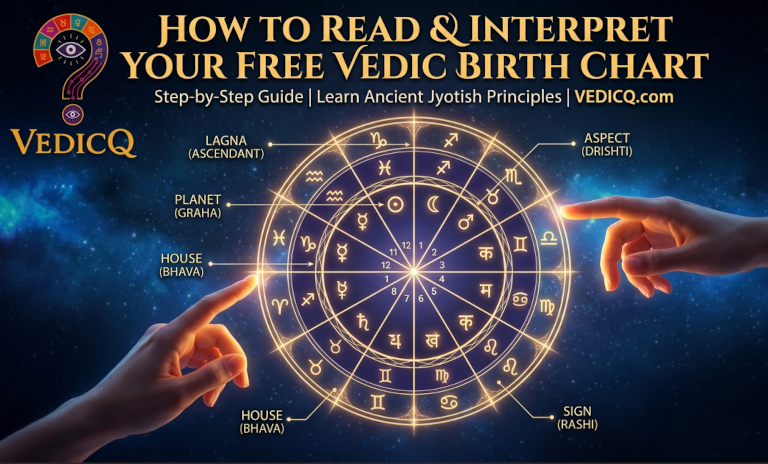
What is a Vedic Birth Chart?
A Vedic birth chart is a two-dimensional circular diagram that represents the positions of all nine planets (Grahas) in the twelve zodiac signs (Rashis) and twelve houses (Bhavas) at the exact moment and location of your birth. Unlike Western astrology, which uses the tropical zodiac, Vedic astrology employs the sidereal zodiac, accounting for the precession of equinoxes and providing more accurate predictions.
Key Components
- Lagna (Ascendant): The rising sign on the eastern horizon at birth - your outer personality
- Chandra Lagna (Moon Sign): Your emotional nature and inner self
- Surya Lagna (Sun Sign): Your core essence and life purpose
- Navamsa (D9): The most important divisional chart for marriage and spiritual growth
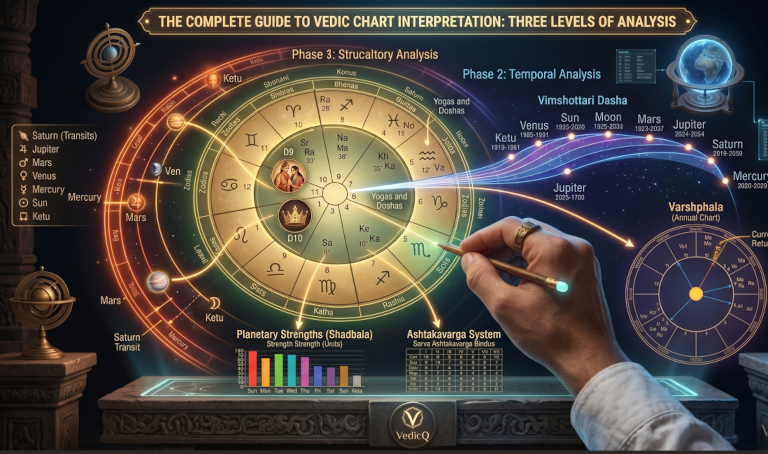
The Three Levels of Analysis
A complete Vedic birth chart reading involves analyzing:
- Structural Analysis: Planetary positions, signs, houses, and aspects
- Temporal Analysis: Dasha periods and timing of events
- Transitory Analysis: Current transits and their interactions with the natal chart
2. The Rasi Chart (D1) - Foundation
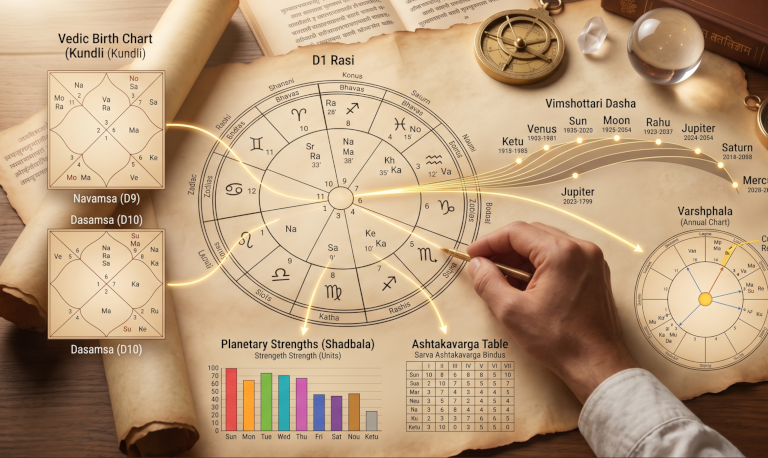
The Rasi chart (also called Lagna chart or D1) is the primary chart that shows the exact position of planets in the 12 signs and 12 houses at birth. It forms the foundation of all Vedic astrology predictions.
Reading the Rasi Chart
The chart is divided into 12 boxes (houses), each representing a specific area of life:
        12th    1st     2nd
        House   House   House
    11th               3rd
    House      ♈       House

    10th               4th
    House               House

     9th               5th
     House       ♎       House

        8th     7th     6th
        House   House   House
Important Considerations in D1
- Sign on Each House: Determines the flavor and expression of that life area
- Planets in Houses: Shows active influences on specific life areas
- House Lords: The ruler of each house and its placement
- Aspects (Drishti): Planetary aspects adding complexity to interpretations
- Conjunctions: Planets together amplifying or modifying each other’s effects
3. Essential Divisional Charts
Divisional charts (Varga charts) are derived by dividing each sign into multiple portions. They provide detailed analysis of specific life areas. The most important ones are:
Navamsa (D9) - The Marriage & Soul Chart
The Navamsa is perhaps the most important divisional chart after D1. It reveals:
- Marriage and partnerships: Timing, nature, and quality of spouse
- Soul development: Spiritual progress and life lessons
- Inner strength of planets: Hidden potentials and weaknesses
- Second half of life: Quality of later years
A planet strong in D1 but weak in D9 may give initial success but ultimate disappointment, while a planet weak in D1 but strong in D9 suggests hidden potential waiting to unfold.
Dasamsa (D10) - Career Chart
The Dasamsa analyzes:
- Career and profession
- Status and reputation
- Professional achievements
- Authority and leadership potential
- Business success patterns
Saptamsa (D7) - Children Chart
For those interested in progeny matters:
- Number of children
- Timing of birth
- Relationship with children
- Children’s fortune and achievements
Dwadasamsa (D12) - Family Chart
Reveals information about:
- Parents and ancestors
- Family environment
- Inherited characteristics
- Domestic happiness
Shodasamsa (D16) - Comforts Chart
Indicates:
- Luxury and comfort
- Vehicles and property
- General happiness
- Environmental factors
Other Important Divisional Charts
| Chart | Division | Purpose |
|---|---|---|
| D1 | Rasi | Main birth chart |
| D2 | Hora | Wealth and finances |
| D3 | Drekkana | Siblings |
| D4 | Chaturthamsa | Fixed assets, Mother |
| D7 | Saptamsa | Children |
| D9 | Navamsa | Marriage, Soul |
| D10 | Dasamsa | Career |
| D12 | Dwadasamsa | Parents |
| D16 | Shodasamsa | Comforts |
| D20 | Vimshamsa | Spiritual pursuits |
| D24 | Chaturvimsamsa | Education |
| D27 | Bhamsa | Strengths & weaknesses |
| D30 | Trimsamsa | Misfortunes |
| D45 | Akshavedamsa | Hidden secrets |
| D60 | Shashtiamsa | Complete life analysis |
4. Planetary Strength Analysis (Shadbala)
Shadbala (sixfold strength) measures the overall power of each planet in your chart. It’s calculated based on six different factors:
The Six Fold Strengths
Sthana Bala (Positional Strength)
- Based on sign placement (exaltation, moolatrikona, own sign, etc.)
- Exaltation: Planet at maximum power (e.g., Sun in Aries, Moon in Taurus)
- Debilitation: Planet at weakest (e.g., Sun in Libra, Moon in Scorpio)
- Own sign: Comfortable position
- Enemy sign: Uncomfortable position
Dig Bala (Directional Strength)
- Planets gain strength in specific directions:
- Sun, Mars, Jupiter: Strongest in 10th house (South)
- Moon, Venus: Strongest in 4th house (North)
- Mercury: Strongest in 1st house (East)
- Saturn: Strongest in 7th house (West)
- Ketu: No directional strength
Kala Bala (Temporal Strength)
- Strength based on time - planetary warps (combust, retrograde)
- Day vs night births
- Season of birth
- Month of birth
Chestabala (Motional Strength)
- Direct planets: Full strength
- Retrograde planets: Additional strength (intensified effects)
- Stationary planets: Reduced strength
- Combust planets: Weakened by proximity to Sun
Drik Bala (Aspectorial Strength)
- Strength from aspects received from other planets
- Full aspects (7th): 100%
- Trine aspects (5th, 9th): 75%
- Square aspects (4th, 8th): 50%
- Conjunction: Full aspect
Naisargika Bala (Natural Strength)
- Inherent strength of planets:
- Sun, Mars, Jupiter: Strong (malefics to enemies, benefics to friends)
- Saturn, Rahu, Ketu: Moderate
- Mercury: Variable
- Moon, Venus: Strong naturally
Interpreting Shadbala
- Strong planets (>300 units): Will give pronounced results during their dashas
- Moderate planets (180-300 units): Normal results
- Weak planets (<180 units): May not give full results or cause delays
5. Ashtakavarga System
Ashtakavarga is a unique predictive system in Vedic astrology that provides a “support system” for each planet and house. It uses a point-based system to indicate favorable and unfavorable periods.
How Ashtakavarga Works
- Seven individual Ashtakavargas: One for each planet (Sun through Saturn)
- Sarva Ashtakavarga: Combined view of all planets
- Bhinnashtakavarga: Each planet’s individual support system
Calculating Points
Each planet’s position is checked from the perspective of all other planets. When a planet is in an unfavorable position relative to another, a point is reduced. Higher points indicate more support and easier results.
Key Interpretations
- Rekha (Lines): Minimum 28 in Sarva Ashtakavarga indicates overall good fortune
- Bindus (Points): Each planet’s total points indicate its capacity to give results
- Avastha: Favorable and unfavorable zones within each sign
6. Vimshottari Dasha System
The Vimshottari Dasha is the most widely used timing system in Vedic astrology. It divides a 120-year life span into major periods (Mahadasha) and sub-periods (Antardasha).
The Planetary Periods
| Planet | Years | Ketu | 7 | Venus | 20 | Sun | 6 | Moon | 10 | Mars | 7 | Rahu | 18 | Jupiter | 16 | Saturn | 19 | Mercury | 17 | Ketu | 7 | |--------|-------|------|---|-------|-----|-----|---|------|-----|------|---|------|----|--------|----|--------|----|----------|-----|
Starting Point
The Vimshottari Dasha sequence begins from your Janma Nakshatra (birth star). Each of the 27 nakshatras is assigned to a planet:
- Ashwini, Makha, Mula → Ketu
- Bharani, Poorva Phalguni, Uttara Phalguni → Venus
- Krittika, Hasta, Purva Ashadha → Sun
- Rohini, Chitra, Chitra → Moon
- Mrigashira, Swati, Shravana → Mars
- Ardrha, Vishakha, Dhanishtha → Rahu
- Punarvasu, Anuradha, Shatabhisha → Jupiter
- Pushya, Jyeshtha, Purva Bhadrapada → Saturn
- Ashlesha, Mula, Uttara Bhadrapada → Mercury
Dasha Sequence
After completing one cycle, the sequence repeats, but the starting point depends on nakshatra position within that nakshatra.
Antardasha (Sub-periods)
Each Mahadasha contains Antardashas of all 9 planets. The sequence within each Mahadasha follows a specific pattern based on the nakshatra pada.
Timing Events with Dasha
- Identify the Mahadasha planet during the period in question
- Check its house placement in your chart
- Examine the Antardasha for timing refinement
- Consider aspects and conjunctions with the Mahadasha lord
7. Gochar (Transits) Analysis
Gochar refers to the current movement of planets through the zodiac. Transits interact with your natal chart to trigger events and provide timing for predictions.
Key Transit Principles
- Slow-moving planets (Saturn, Rahu, Ketu, Jupiter) create major, lasting effects
- Fast-moving planets (Moon, Mercury, Venus) create temporary fluctuations
- Transit aspects to natal planets activate those planet’s significations
- Combined transits of multiple planets create major life events
Important Transit Combinations
| Transit | Effect |
|---|---|
| Jupiter transiting 1st, 5th, 9th | General luck and expansion |
| Saturn transiting 1st, 4th, 7th, 10th | Sade Sati periods, Karmic lessons |
| Rahu/Ketu transiting angle houses | Major life changes |
| Jupiter-Saturn conjunction | Global shifts |
| Mars with Rahu/Ketu | Aggressive events |
Natal vs Transit
- Natal position: Your baseline tendencies
- Transit position: Current energies activating those tendencies
- Combined effect: Where these intersect determines event manifestation
8. The Houses of Vedic Astrology
The twelve houses represent different areas of life. Each house is influenced by:
- Its natural significations
- The sign on its cusp
- The planet occupying it
- The house lord’s placement
- Aspects received by the house
House Meanings
| House | Name | Natural Significations |
|---|---|---|
| 1st | Lagna | Self, personality, health, longevity |
| 2nd | Dhana | Wealth, family, speech, food |
| 3rd | Sahaja | Siblings, courage, communication, efforts |
| 4th | Sukha | Mother, home, happiness, property |
| 5th | Putra | Children, creativity, education, romance |
| 6th | Roga | Health, enemies, debts, service |
| 7th | Kama | Marriage, partnerships, business |
| 8th | Mrityu | Longevity, secrets, transformation, inheritance |
| 9th | Bhagya | Fortune, father, spirituality, higher education |
| 10th | Karma | Career, reputation, authority |
| 11th | Labha | Gains, friends, desires, achievements |
| 12th | Vyaya | Losses, expenditure, foreign travel, liberation |
House Lord Analysis
The placement of each house lord reveals:
- Where its energies will manifest in life
- How challenges and opportunities will present themselves
- Which areas of life are emphasized
9. Yogas and Doshas
Yogas are specific planetary combinations that create powerful effects, while Doshas are challenging configurations requiring remedies.
Major Yogas
Wealth Yogas
- Dhana Yoga: Strong 2nd, 5th, 9th, 11th houses
- Lakshmi Yoga: Strong Venus in wealth houses
Power Yogas
- Raj Yoga: Lords of Kendra (1,4,7,10) and Trikona (1,5,9) in conjunction/aspect
- Nabhasha Yoga: Special yogas when certain conditions are met
Intelligence Yogas
- Budhaditya Yoga: Sun-Mercury conjunction
- Saraswati Yoga: Mercury, Jupiter, Venus in Kendra from Lagna
Important Doshas
| Dosha | Cause | Effect | Remedy |
|---|---|---|---|
| Manglik | Mars in 1,2,4,7,8,12 | Marriage challenges | Kumbh Vivah, Puja |
| Nadi | Same Nadi in both charts | Health issues for children | Medical astrology consultation |
| Kaal Sarpa | All planets between Rahu-Ketu | Instability, struggles | GEM, Mantras |
| Pitru | Afflicted 9th house | Ancestral karma | Tarpan, Shradh |
10. Varshphala (Annual Chart)
Varshphala (also called Muhurta Lagna or Solar Chart) is a predictive technique for the year, calculated from your birthday to birthday.
How to Calculate Varshphala
- Take the Sun’s position at birth
- At each birthday, erect a new chart with that Sun position as Ascendant
- This chart shows themes and events for the coming year
Using Varshphala
- Lagna position: Overall theme of the year
- Moon sign: Emotional landscape
- Planet in 1st house: Key energy for the year
- Major transits in Varshphala: Timing of events
Limitations
- Varshphala is most accurate when birth time is precise
- Should be used alongside natal analysis and transits
- Better for general themes than specific event timing
11. Putting It All Together
A complete Vedic birth chart interpretation follows a systematic approach:
Step 1: Foundation Analysis
- Check Lagna strength and planetary positions in D1
- Analyze the Navamsa for inner strength
- Identify major Yogas and Doshas
Step 2: Timing Framework
- Calculate Vimshottari Dasha sequence
- Identify current Mahadasha and upcoming periods
- Check Antardasha within current Mahadasha
Step 3: Event Timing
- Apply transits to natal and Varshphala charts
- Use Ashtakavarga for period assessment
- Cross-reference Dasha, transit, and annual chart
Step 4: Life Area Focus
- Analyze specific houses based on query
- Consider house lord placements
- Check divisional charts for detailed analysis
Step 5: Remedial Measures
- If Doshas are significant, recommend appropriate remedies
- Consider gem therapy, mantras, pujas
- Suggest timing for important activities
Conclusion
Mastering Vedic birth chart interpretation requires years of study and practice. This guide provides the foundational framework, but true expertise comes from:
- Studying classical texts (Brihat Parashara Hora Shastra, Sarvartha Chintamani)
- Regular chart practice and observation
- Understanding the philosophical underpinnings of Jyotisha
- Keeping accurate records of predictions and outcomes
Vedic astrology is not just about prediction—it’s a sophisticated system for self-understanding, spiritual growth, and aligning with cosmic rhythms. Whether you’re a beginner or advanced student, may this guide illuminate your journey through the cosmic blueprint of life.
Key Takeaways
- D1 (Rasi chart) is the foundation; all other analysis builds upon it
- Navamsa (D9) is crucial for understanding soul-level indications and marriage
- Shadbala measures planetary strength objectively
- Vimshottari Dasha provides the timing framework for events
- Transits activate and trigger natal potential
- Yogas and Doshas highlight significant configurations
- Varshphala offers annual predictive insights
For a personalized birth chart analysis using these comprehensive techniques, visit VedicQ and experience AI-powered Vedic astrology interpretation grounded in authentic Jyotish principles.