· VedicQ · Tutorials · 6 min read
Vedic Birth Chart Interpretation - Understanding Your Cosmic Blueprint
Comprehensive guide to Vedic birth chart interpretation covering planetary dignity, house analysis, Nakshatras, divisional charts, and predictive techniques for accurate horoscope reading.
🚀 Meet VedicQ: Your Authentic AstroChart AI Advisor
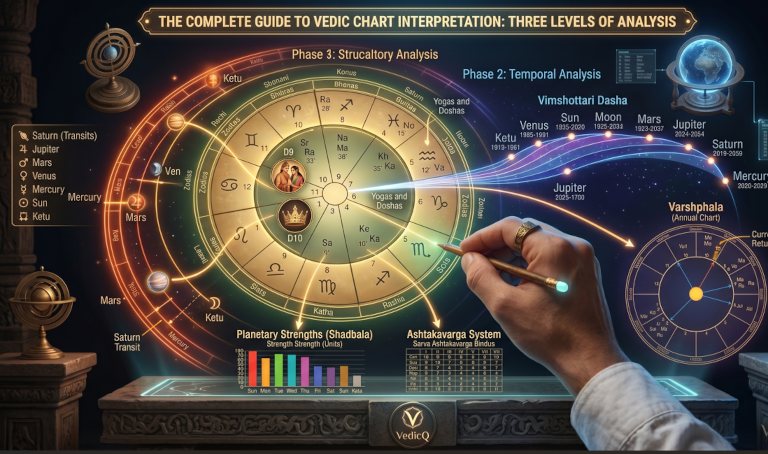
Instantly generate your precise Kundli and divisional charts (D1, D2, D4, D7, D9, D10, and more) with no waiting and no pandit needed, and chat or talk to our 24/7 Live AI Astrologer with real-time voice call in 100+ languages.
Get detailed predictions, Yogas, Doshas, Vimshottari Dasha, and Shadbala calculations based purely on Vedic principles, not random AI.
🎁 Experience pure astrology with zero guesswork. Try both AI Chat and Live Voice Talk free today using the promo code: WELCOME25.


Vedic Birth Chart Interpretation: Understanding Your Cosmic Blueprint
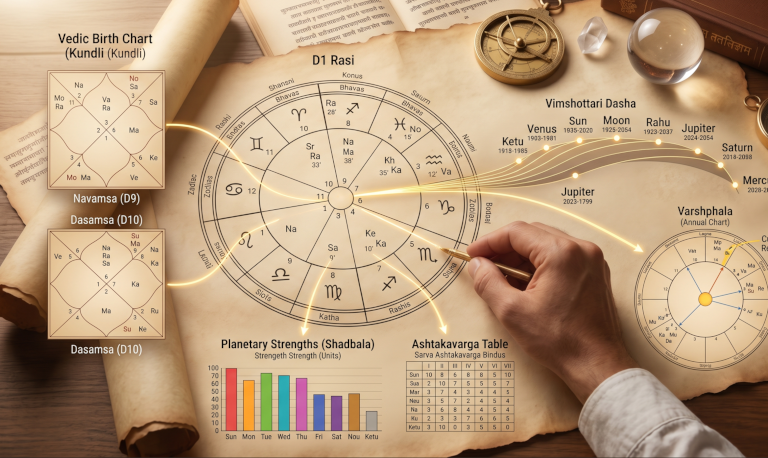
The Vedic birth chart (Kundli) is a complex map of the heavens at the moment of your birth. Understanding how to interpret this cosmic blueprint opens doors to profound self-knowledge and accurate life predictions. This guide covers every essential aspect of birth chart interpretation in Vedic astrology.
Table of Contents
- Foundation of Vedic Birth Chart Interpretation
- Planetary Dignity and Strength
- House Analysis in Depth
- The Role of Nakshatras
- Divisional Chart Analysis
- Predictive Timing Techniques
- Advanced Interpretation Principles
- Case Study: Reading a Birth Chart
1. Foundation of Vedic Birth Chart Interpretation
The Three Pillars of Jyotish
Every Vedic birth chart reading rests on three fundamental pillars:
- Graha (Planets): The active agents - what is happening
- Rashi (Signs): The mode of expression - how it happens
- Bhava (Houses): The arena - where it happens
The Birth Chart Structure
A standard Vedic chart displays:
- The Lagna (Ascendant): The eastern horizon point at birth
- The twelve Bhavas: Houses representing life areas
- The twelve Rashis: Signs placed in each house
- The nine Grahas: Planets positioned in signs and houses
Key Principles of Interpretation
Principle 1: Nothing operates in isolation A planet’s effects depend on its sign, house, aspects, dignity, and current dasha.
Principle 2: The whole chart matters Isolating single positions leads to incomplete readings. Always see the chart as an integrated whole.
Principle 3: Dignity determines outcome A strong planet gives its results easily; a weak planet gives them with difficulty or in modified form.
2. Planetary Dignity and Strength
The Five Dignities
Each planet can be in one of five states of dignity:
| Dignity | Meaning | Effect Multiplier |
|---|---|---|
| Exaltation | At maximum strength | 150% |
| Moolatrikona | Own sign (secondary) | 125% |
| Own Sign | Natural home | 100% |
| Enemy Sign | Weakened | 50-75% |
| Debilitation | At maximum weakness | 25-50% |
Exaltation and Debilitation Points
| Planet | Exaltation | Debilitation |
|---|---|---|
| Sun | Aries (10°) | Libra (10°) |
| Moon | Taurus (3°) | Scorpio (3°) |
| Mars | Capricorn (28°) | Cancer (28°) |
| Mercury | Virgo (15°) | Pisces (15°) |
| Jupiter | Cancer (5°) | Capricorn (5°) |
| Venus | Pisces (27°) | Virgo (27°) |
| Saturn | Libra (20°) | Aries (20°) |
Additional Strength Factors
Beyond basic dignity, planets gain or lose strength from:
- Directional Strength (Dig Bala)
- Temporal Strength (Kala Bala)
- Motional Strength (Chestabala)
- Aspectorial Strength (Drik Bala)
- Natural Strength (Naisargika Bala)
Practical Application
When interpreting:
- Strong planets in good houses = easy, pronounced results
- Strong planets in challenging houses = results manifest despite obstacles
- Weak planets in good houses = results delayed or modified
- Weak planets in challenging houses = significant life struggles
3. House Analysis in Depth
The Natural Zodiac
Each house has natural significations that are always relevant:
| House | Natural Significations |
|---|---|
| 1st | Self, body, health, appearance |
| 2nd | Wealth, family, speech, food |
| 3rd | Siblings, courage, communication |
| 4th | Mother, home, property, happiness |
| 5th | Children, creativity, education |
| 6th | Enemies, disease, service |
| 7th | Marriage, partnerships |
| 8th | Longevity, transformation, secrets |
| 9th | Fortune, spirituality, father |
| 10th | Career, reputation, authority |
| 11th | Gains, friends, wishes |
| 12th | Losses, foreign travel, liberation |
House Lord Analysis
The placement of each house lord is crucial:
Example: If your 7th house (marriage) lord is in the 10th house (career):
- Marriage may come through career connections
- Spouse may be professionally successful
- Career may affect marital harmony
Quadrants and Tricons
Quadrants (Kendra): 1st, 4th, 7th, 10th houses
- Represent worldly achievements
- Strength here is crucial for success
Tricons (Trikona): 1st, 5th, 9th houses
- Represent spiritual and fortune
- Good trine strength indicates blessings
Upachaya Houses
The 3rd, 6th, 11th houses are called Upachayas (growth houses):
- Weak planets here can improve over time
- These houses govern overcoming challenges
- Good for analyzing enemies, efforts, and gains
4. The Role of Nakshatras
The 27 Lunar Mansions
Nakshatras provide deeper analysis beyond the signs. Each Nakshatra has:
- A ruling planet
- A symbol (symbolic meaning)
- A deity (cosmic energy)
- A quality (animal nature)
Quick Reference: Nakshatra Groups
| Quarter | Quality | Characteristics |
|---|---|---|
| 1-9 | Devata | Divine, spiritual, introverted |
| 10-18 | Manava | Human, balanced, practical |
| 19-27 | Pasu | Animal, worldly, extroverted |
Nakshatras in Chart Interpretation
- Janma Nakshatra: Determines starting point of Vimshottari Dasha
- Naksha pada: Refines Dasha sub-period calculations
- Compatibility: Nakshatra matching for relationships
- Personality: Adds subtle character nuances
Important Nakshatra Combinations
- Same Nakshatra: Strong connection, similar life path
- Compatible Nakshatras: Harmonious relationship
- Incompatible Nakshatras: Areas of friction
5. Divisional Chart Analysis
Why Divisional Charts Matter
The main chart (D1) shows general tendencies, but divisional charts reveal specific life areas in detail.
Essential Divisional Charts
D9 - Navamsa (Most Important)
- Marriage and spouse
- Spiritual progress
- Inner strength of planets
- Second half of life quality
Interpretation Rule: A planet weak in D1 but strong in D9 has hidden potential; a planet strong in D1 but weak in D9 loses its power over time.
D10 - Dasamsa
- Career and profession
- Professional status
- Business success
- Authority and reputation
D2 - Hora
- Wealth and financial matters
- Day-to-day income
- Financial management
D7 - Saptamsa
- Children
- Progeny matters
- Relationship with children
Advanced Divisional Charts
| Chart | Division | Purpose |
|---|---|---|
| D12 | Parents, ancestors | |
| D16 | Comforts, vehicles | |
| D20 | Spiritual pursuits | |
| D24 | Education, learning | |
| D30 | Misfortunes, sorrows | |
| D60 | Complete life analysis |
6. Predictive Timing Techniques
Vimshottari Dasha System
The primary timing system in Vedic astrology:
Mahadasha (Major Period): 6-20 years per planet Antardasha (Sub-period): Proportional division within Mahadasha
Dasha Order
Ketu (7) → Venus (20) → Sun (6) → Moon (10) → Mars (7) → Rahu (18) → Jupiter (16) → Saturn (19) → Mercury (17) → Ketu (7)…
Reading Dasha Results
When interpreting a Dasha period:
- Nature of the Dasha planet: Its significations
- House it occupies: Where effects manifest
- Its dignity: How easily it gives results
- Aspects on it: Other influences
- Antardasha planet: Modifying the results
Transit Analysis (Gochar)
Current planetary positions interact with natal chart:
Strong Transits:
- Saturn (28.5 years cycle)
- Jupiter (12 years cycle)
- Rahu/Ketu (18.6 years cycle)
Fast Transits:
- Moon (27 days)
- Mercury (1 year)
- Venus (1 year)
- Mars (45 days)
7. Advanced Interpretation Principles
Planetary Relationships
Friendship Table
| Planet | Friends | Enemies | Neutral |
|---|---|---|---|
| Sun | Moon, Mars, Jupiter | Venus, Saturn | Mercury |
| Moon | Sun, Mercury | None | Others |
| Mars | Sun, Moon, Jupiter | Mercury | Venus, Saturn |
| Mercury | Sun, Venus | Moon | Mars, Jupiter |
| Jupiter | Sun, Moon, Mars | Mercury | Venus, Saturn |
| Venus | Mercury, Saturn | Sun, Moon | Mars, Jupiter |
| Saturn | Mercury, Venus | Sun, Moon | Mars, Jupiter |
Natural Friendships: Sun/Moon, Mars/Jupiter, Mercury/Venus, Saturn with both
Aspect Patterns
Full Aspects (100%): 7th house Trine Aspects (75%): 5th and 9th houses Special Aspects:
- Mars → 4th, 7th, 8th
- Jupiter → 5th, 7th, 9th
- Saturn → 3rd, 7th, 10th
Special Yoga Formation
Raj Yoga: Kendra + Trikona lords conjunction/aspect Viparita Raj Yoga: Bad houses (6,8,12) as Kendra Dhana Yoga: Strong 2nd, 5th, 9th, 11th houses Sakata Yoga: Moon in 6th, 8th, or 12th from Jupiter
8. Case Study: Reading a Birth Chart
Sample Chart Analysis
Let’s examine a chart with these placements:
- Lagna: Scorpio (debilitated Moon)
- Moon: Taurus (exalted)
- 7th house: Pisces with Jupiter
- 10th house: Capricorn with Mars
Step-by-Step Interpretation
Step 1: Assess Lagna Strength Scorpio Lagna has Mars as lord. Mars in 10th house (career) in Capricorn indicates:
- Strong career drive
- Leadership abilities
- Some tension in expressing emotions
Step 2: Evaluate Key Planets Moon in Taurus (exalted) in 2nd house:
- Emotional stability
- Good family life
- Practical approach to finances
Step 3: Check Relationships Jupiter in 7th house:
- Benefic influence on marriage
- Philosophical spouse
- Possible spiritual partner
Step 4: Identify Challenges Debilitated Lagna lord requires attention:
- May face identity challenges
- Need to develop emotional maturity
- Remedies may help balance energies
Predictions Based on This Sample
- Career: Strong focus, leadership path
- Marriage: Favorable timing, philosophical partner
- Wealth: Stable finances with gradual growth
- Challenges: Emotional expression, identity consolidation
Conclusion
Mastering Vedic birth chart interpretation requires understanding:
- Planetary dignity determines strength
- House analysis reveals life areas
- Nakshatras add depth
- Divisional charts provide specificity
- Dasha timing gives temporal framework
- Transits activate potentials
The key is viewing the chart as an integrated system where every element influences every other. Strong planets give their results; weak planets give modified results; and timing (Dasha) determines when these effects manifest.
For professional-grade birth chart interpretation powered by AI, visit VedicQ. Our system analyzes thousands of factors including all divisional charts, yogas, doshas, and dasha periods for accurate, personalized predictions.
Remember: The birth chart is a map of potential. How those potentials manifest depends on free will, karma, and the timing activated by Dasha periods.